ITDownload free

Everything it does

From the first to the last.

Everything SemSync does today: sync, editing in time with the music, colour, the eye on the footage, reels and vertical, voice, clips, tools and SemSync Live.

The sync

The cameras lock onto each other, from the sound

No timecode, no clapperboard, no files to rename. And what locks stays locked all night long.

Locked to the millisecond

0.1 ms of error on the known-truth bench, on a techno loop degraded down to -15 dB.

The drift, told in seconds

Every camera has its own clock and no two run the same. SemSync corrects all night and writes down how many seconds that camera would have drifted without it. Not parts per million: seconds and frames.

Even with no mixer audio

If the recorder was not there, you pick which camera acts as the reference and the job runs anyway: 20 clips out of 20 locked on a real night.

The health of the audio, before it starts

A file that is heavy but silent, or a dead mixer, is set aside first, and you are told why that clip does not lock.

The job checks itself

Once the sync is done, SemSync looks at its own work the way an editor would: two clips of the same camera on top of each other, a clip out of shooting order, a cut of a few frames. What is certain it fixes, the rest it marks for you in Resolve.

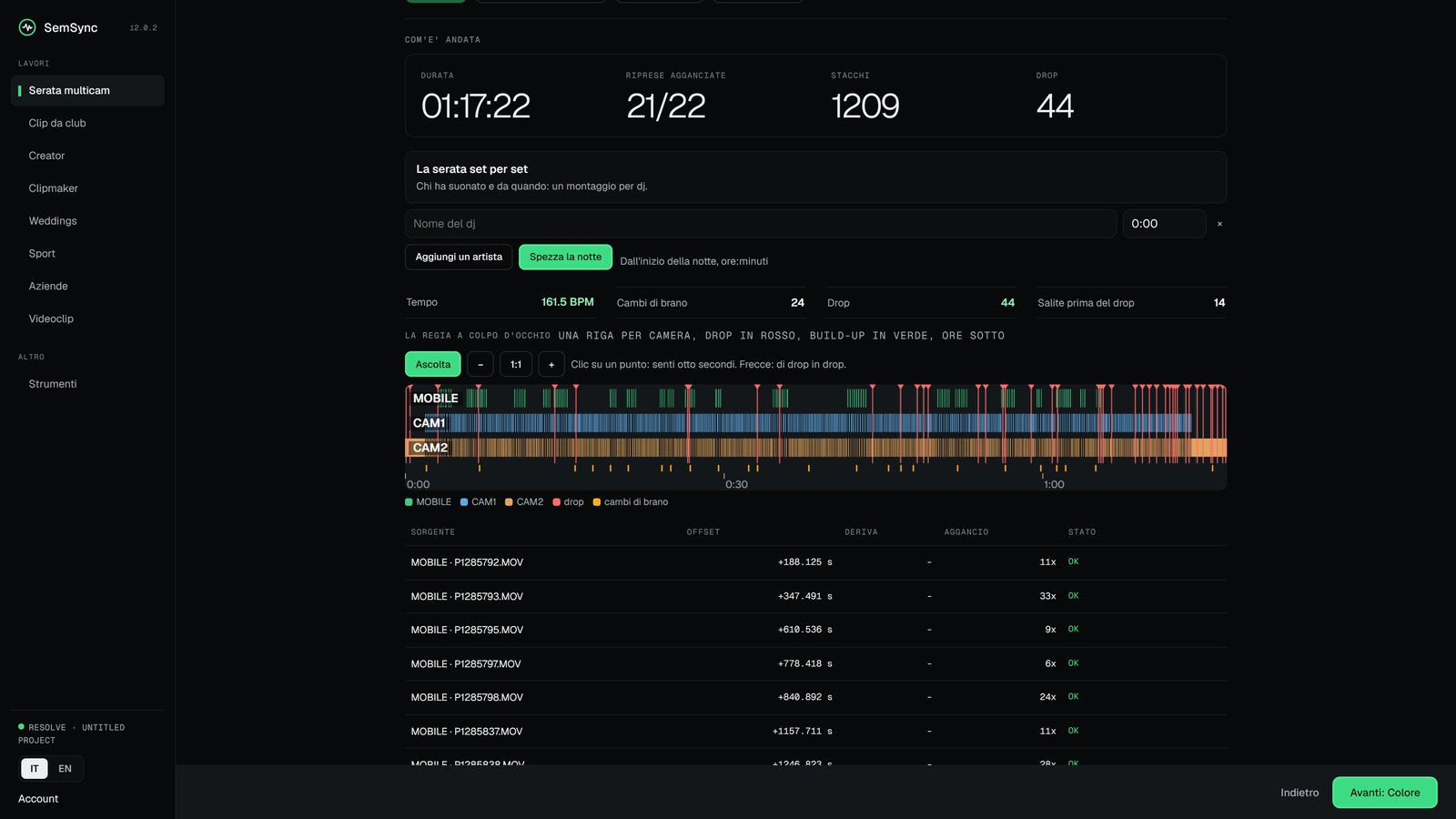
Every source, in writing

Offset, drift, lock strength and state, one row per file. If a clip did not lock you read it there, before you open Resolve.

Sync
The sync results, source by source

The edit

The cut lands where the music rises, not on the next bar

At 128 BPM a bar lasts almost two seconds: right in time, wrong in place. SemSync goes down to the instant.

On the instant, not on the grid

The cut lands on the frame that contains the rise, never the next one. On a real night up to 114 thousandths of offset were put right.

Drops and energy changes

The drop is the real attack of the hit. And when the dj pulls down or the music comes back, the camera changes where the level changes: 32 changes out of 32 on the bench.

The structure of the track

Intro, build, drop, body: scenes last what the point they start from asks for. No scene steps over a drop.

The breathing of the track

Beyond the sections, the edit follows the sixteen-bar phrases the ear already hears. Not inside the drop: there the hit is in charge.

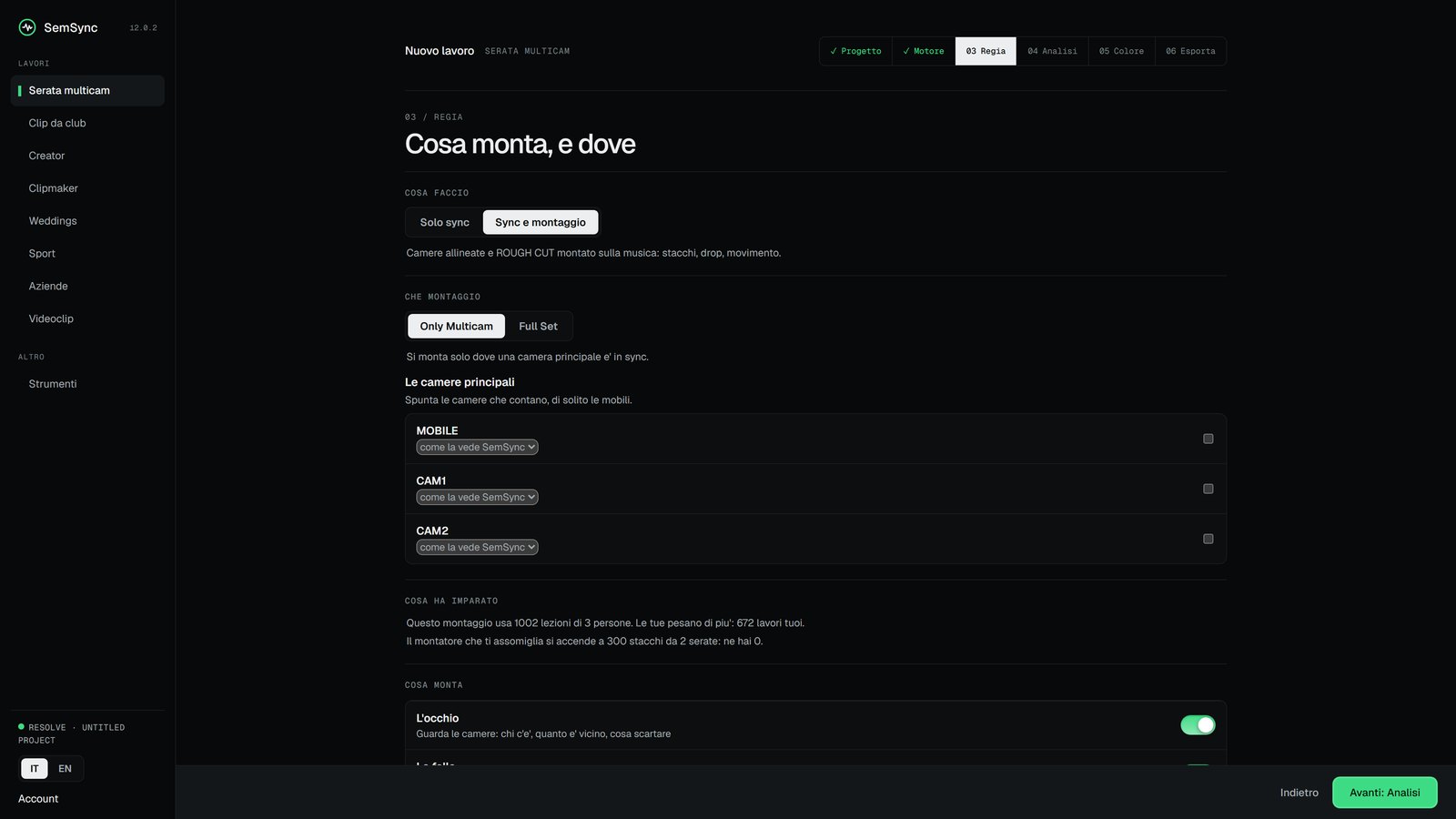
How much room each camera gets

A slider per camera says how much of the edit it should take, a radio button says which one goes on the drop, and a colour bar shows at a glance how the night is shared out. It is not a loaded dice: it is a count, and the camera furthest behind its share goes on air.

The genre of the night

Tech house, hard techno, melodic, trance, afro: the rhythm of the edit changes with the genre. We measured the genre fingerprints on 5,368 freely licensed tracks, across 26 genres.

Edit style
The Edit step, with the camera weights

Colour

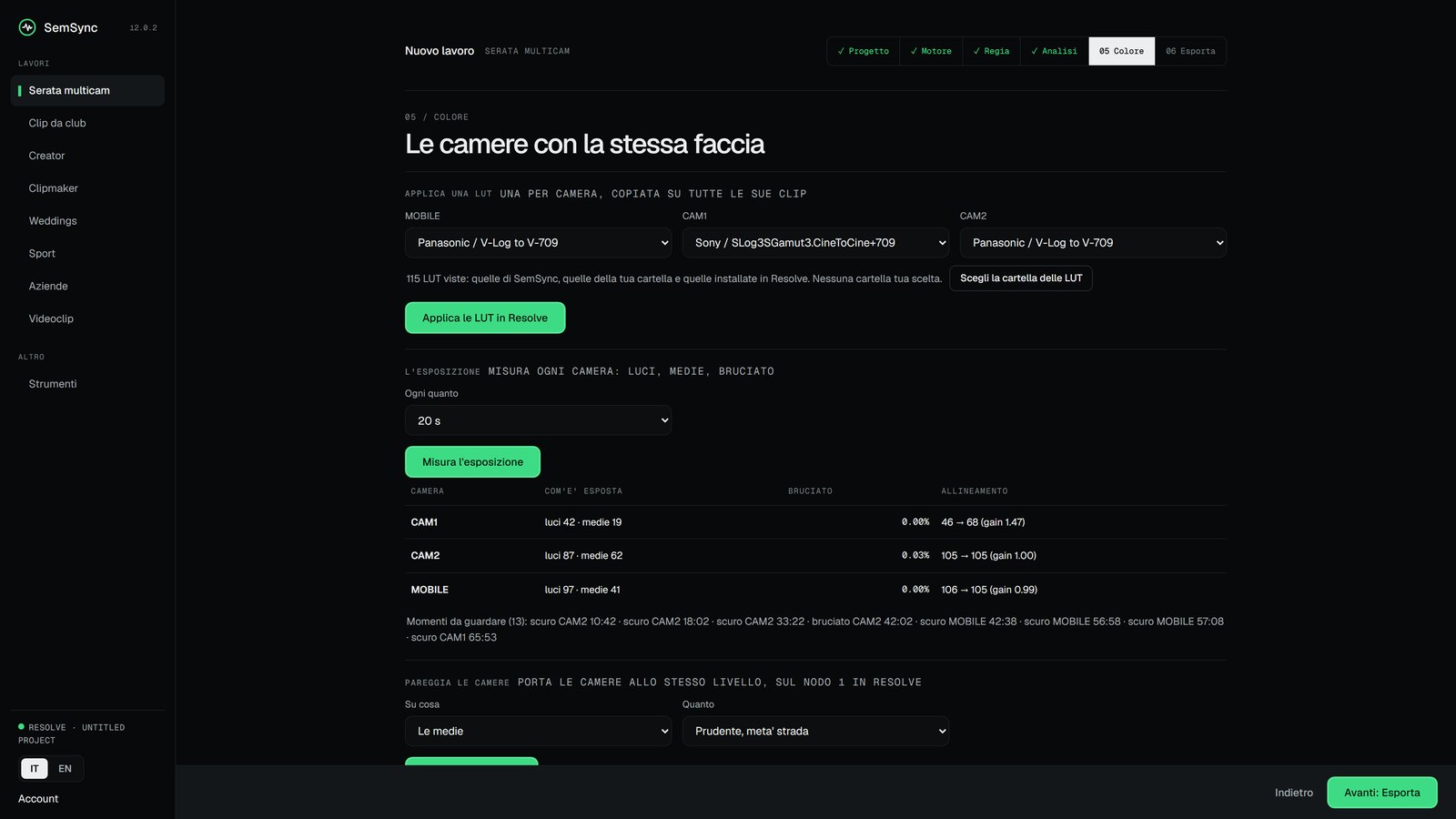
One LUT per camera, then it checks it actually landed

Puts the right LUT on each camera, checks it actually went on, and evens out the exposure from one camera to the next.

One per camera, on all of its clips

The LUT goes on that camera's first clip and is copied onto all of its clips. Then SemSync reads back from Resolve how many clips really have it, because Resolve answers 'done' even when it did nothing.

Your LUTs, where you keep them

The list looks in three places: the ones that come with the program, your folder (you pick it once and it holds for every job) and the ones installed in Resolve.

The exposure measure

Camera by camera: highlights, mids, how much you clipped and how far apart they are. Plus the list of moments to check, with the timecode.

Matching the cameras

The balance works clip by clip, not track by track: in the finished edit the cameras all sit on the same track, one after another.

Colour
The Colour step, one LUT per camera

The eye

It does not only listen: it looks at the footage

Before editing, every shot is actually looked at, piece by piece.

It sorts the footage

It sorts clips by category (the detail, the chef, the room, the dj, the crowd, the aerial), measures whether they are sharp, exposed and steady, marks the heart of every clip and sets the rejects aside.

It checks whether something happens

Not just how the shot is made: whether there is a gesture inside it. Where the category promises movement, a perfect still loses to a living shot.

Even when the light strobes

In a club the strobe changes the exposure between one frame and the next, and it is why vision systems born on sports fields break in a nightclub. With the flashes, tracking goes from 14 points out of 300 to 300 out of 300.

And it knows what is beautiful

With similarity and technique equal, between two shots it picks the more beautiful one, and the opening demands more of it.

The reel and the vertical

You write the storyboard, or it writes it

Written, dictated, or imported. Or proposed from your own footage, following the steps of the story.

The frame follows the subject

In 9:16 the crop follows faces and detail, smoothed and speed limited: not the centre of the frame.

The length drives the rhythm

Fifteen seconds is a tight reel, forty-five breathes: it changes the pace of the edit, not just how many shots fit.

The layer that makes it feel like a reel

The frame moves slowly where the shot is still, the whoosh lands a sixth of a second before the cut, the impact only if the cut sits on a strong beat, and overlays one every three scenes.

Your effects library

The folder where you keep overlays and transitions is picked once and holds for every job. Transitions straddle the cut, half out and half in, so the reel still assembles by copy.

And the colour, already done

Anyone shooting a flat profile used to get a milky reel: now levels, white balance and saturation sort themselves out, measured on the frames already read.

The voice

Subtitles, chapters and copy, without sending anything anywhere

The voice is recognised on your own computer. No file leaves the building.

Subtitles

Written from the voice onto the already trimmed timeline, in Italian, English and other languages, even without Resolve.

Chapters and copy

YouTube chapters, title, description and hashtags taken from what you actually said, not from a template.

Fillers out

Pauses and filler words are taken out on their own, and the thumbnail is the sharpest frame in which you are talking to camera.

The tools

The boring things, done for you

Renames the footage, builds the proxies, cleans up the audio, writes the chapters and packs the folder to hand to the client.

The level and the footage check

Before you start: what you shot, at what frame rate, what does not add up.

Convert for Resolve

The formats Resolve struggles with become files it opens without thinking.

Disk cleanup

It tells you where the space went (including the system data nobody can explain) and sends caches and temporary files to the bin. To the bin, never for good.

The computer

RAM, processor, the night's drive and the graphics card, before you start, with who is hogging what and what is worth closing.

The queue of nights

A folder with several nights inside: SemSync works them one after another, even with nobody watching.

SemSync learns

The more nights it sees, the more it edits like you

It learns how you cut and how your genre sounds, so the next night's edit looks more like you. Numbers only: your footage never leaves your machine.

What a lesson is

The numbers of a night: genre, BPM, how many drops per minute, how long the cuts last, where you corrected, and whether something broke. Never the audio, never the video, never a name.

First it learns from you

From the third job your corrections count more than the genre: if you always shorten the cuts, it starts shortening them itself. The timelines you finish in Resolve teach it which camera you pick and when.

Then from the world

Every day it downloads everyone's knowledge, signed by the server and locked inside declared boundaries: an identity card per genre, not a model that changes its mind overnight.

And it checks itself

A report card compares jobs with and without each learned number and switches off the one that makes you correct the most.

You can switch it off

One switch in Account, and SemSync stops learning and stops sending anything.

The first thousand lessons came from the beta nights and from our own test runs, since 2 September 2026.

The program

One package, and every error says what to do

One package to download, in English and Italian, and every error tells you what to do instead of showing a code.

Windows and Mac, the same file

There is no Windows build and a Mac build to keep in step: it is the same package, from the same link. On Mac it runs the same code, tried on two real Macs from the install to the export.

Dark, because you work at night

The page is born dark, from the very first instant, with no white flash in your face at four in the morning. The light theme is still there, in Account.

Italian and English, front and back

Every sentence the program says exists in both languages, including the ones coming from the engine: a test turns red if tomorrow we write one without its English.

Every error has a verb

Never 'check the log'. It says what is wrong and what to do now, and where the box is.

Nothing goes online

The work all runs on your computer. The internet is only needed to link your account, then you can work offline.

The clips

Loose clips, cut on the hit

What the venue and the artist ask you for the next day.

One clip for every drop

The night gives you vertical clips, each starting on the hit, with the clean mixer audio underneath instead of the camera's.

More than one clip per shot

A long shot gives several pieces, and twenty seconds are left between one clip and the next, so they do not all look alike.

The Clipmaker, for social

Loose clips with no music: food, room, people. It spots LOG from the metadata and applies the camera's LUT, slows down where it can and lays a base grade.

Inside Premiere Pro

SemSync lives inside Premiere

You open it from Window > Extensions, and the edit lands in the project you have open.

A panel, not another program

Inside the panel there is the whole of SemSync, not a cut-down version: pick the folder, run the job, look at the results, without ever leaving Premiere.

The timeline arrives on its own

The button says Send to Premiere, and SYNC MAP and ROUGH CUT appear in the open project, in a bin of their own, with the edit already open on the timeline. No file to go and find, no Import.

One button installs it

Open SemSync, go to ACCOUNT and press Put it inside Premiere. Then close Premiere and reopen it. On Windows, with Premiere Pro 2022 and up. It has just landed: if you open the panel, write and tell us how it went.

From the card to the timeline

How a night goes, from start to finish

The first time it takes ten minutes to set up. From the second, two.

1. You install it, once

The installer puts the icon on the desktop and in the Start menu (in Applications on Mac). If Python is missing, it walks you through it.

2. You activate your account

You paste the code and press Activate: ten seconds.

3. You say what the job is

Name, genre, how many cameras, whether there is a mixer. SemSync creates the folders and, inside Resolve, the project with its timeline.

4. You copy the cards

One folder per camera, one for the mixer. SemSync tells you how many clips it sees in each one.

5. You pick the style and press

How much room each camera takes, which one goes on the drop, how often it cuts. Then Start.

6. You watch it happen

The phases, the live numbers, the sources locking one after another, and the time.

7. You open Resolve

Inside you find SYNC MAP, one track per camera with everything aligned, and ROUGH CUT, the edit. From there the work is yours.

The question everybody asks

Doesn't Resolve already do this?

Some of it yes, and it is only fair to say so. The rest no, and nobody does it.

What Resolve already does, free

It aligns clips on the audio waveform when the clips look alike, and cuts multicam following whoever is speaking. If that is your job, use Resolve and save your money.

What nobody does

Holding six hours of club while correcting each camera's drift, locking onto repetitive music, putting the cut on the instant the frequency rises instead of on the bar, and editing along drops, energy changes and the structure of the track.

And what it leaves in your hands

Not a finished video to take or leave: a real timeline, with your own clips inside, that you open and change as you like.

What you need

What to buy, and what is enough to prepare

Less than you think. The gear you already have is fine.

The cameras

The ones you have. They do not need to match, you do not need timecode, you do not need genlock. Each one needs to record audio too, even bad audio: that is what makes them lock.

The reference audio

A line from the mixer into a recorder, even a cheap one. If you have none, a camera is used as the reference.

The computer

The one you already edit on. Before starting, SemSync tells you whether RAM, disk and graphics card will hold, and what is worth closing.

Resolve Studio, Premiere, or the file

Studio is the only version of Resolve that takes commands from outside, and that is where SemSync builds the project. In Premiere Pro there is the panel: SemSync sits inside it and the timeline goes into the open project. With free Resolve or Final Cut Pro, SemSync writes the timeline file and you import it.

SemSync Live · beta by invitation

The same head, while the night is happening

What SemSync does the morning after on the footage, Live does live: it hears the music and changes camera at the right moment, driving OBS and the ATEM.

SemSync Live · a simulated night, right nowopen it full size ↗
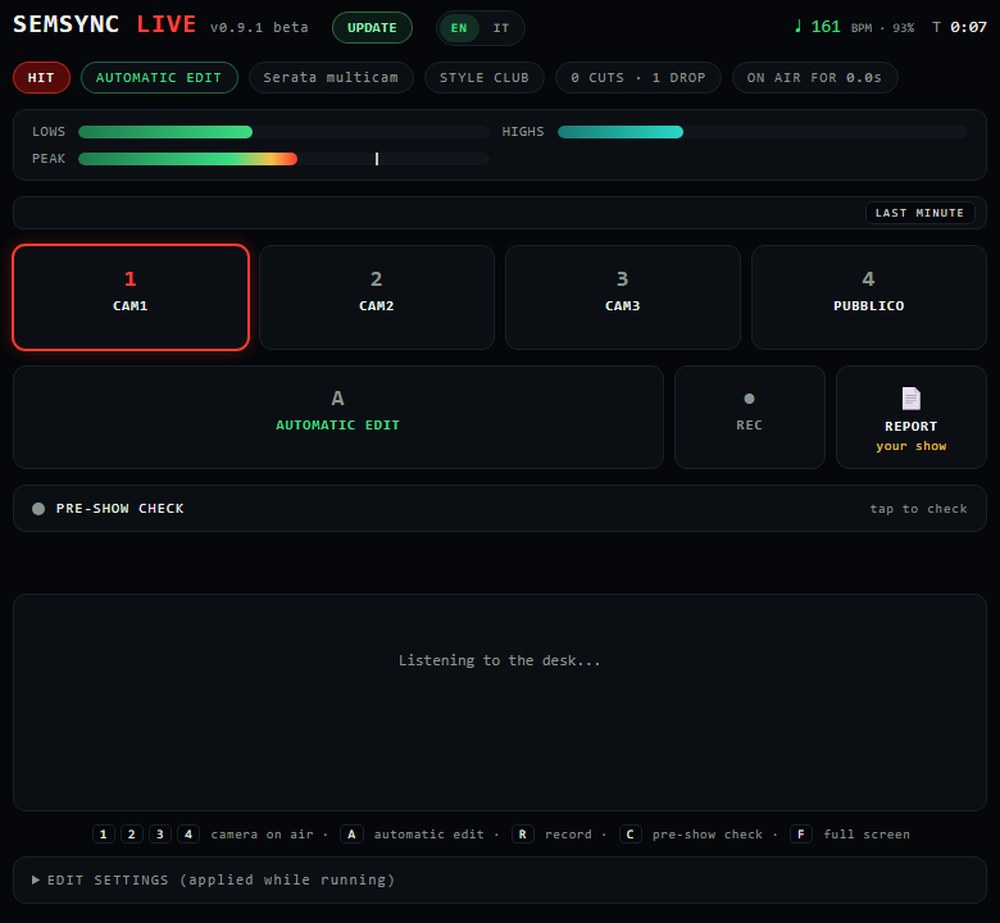
SemSync Live
The director's panel

The panel lives on a laptop wired to the mixer. From a computer this page lets you try it: a simulated night runs, and you press a camera to take over.

It feels the drop coming

The build is heard before the hit lands, and the camera is already the right one when it does.

It cuts on the beat

Changes fall in time, not whenever.

Your hand stays on it

You can take over at any moment, and Live learns from how you take over.

Tonight's stream is tomorrow's edit

What went on air comes back as a rough cut, with the mixer audio as the reference.

The check before you go on

Cameras, audio and connections checked one by one, with what is missing written down.

Your stream, on one page

At the end of the night a report to hand to the venue, with the logo of whoever shot it.

SEMSYNC LIVE · BETA by invitation. The system drives OBS and the ATEM from a laptop wired to the mixer. If you want to try it, write to us: we take a few at a time, because we follow every install ourselves.

Want LIVE in your venue?

We are setting it up in the first venues. Leave your email and we get back to you for a quote, and nothing else.

Six jobs

Inside you only find what this job needs.

Clubs, festivals, concerts

Multicam night

Three cameras and the mixer become an edit cut on the drops and the energy changes. The sync needs no timecode and no clapperboard. And if the party runs all night, every set comes out on its own, one after another, vertical too.

The page
Card dump, the day, the project

Weddings

SemSync reads the card dump, warns you if a file is missing, splits the day into moments and hands you the project tidy in folders, in Resolve or in Premiere.

Inside SemSync
Corporate, conferences, podcasts

Business

The edit follows whoever is speaking, chapters and subtitles come from the voice, and the client gets a folder ready to use.

The page
Playback, set, effects

Music videos

Several takes of the same playback lock onto each other, and the edit follows the structure of the track.

Inside SemSync
Reels, YouTube, subtitles

Creator

The eye watches all the footage, picks the good shots and builds the reel from the storyboard, vertical, following the subject.

The page
Restaurants, venues, hotels

Clip maker

From lots of loose shots comes the best piece of each one, slowed down where it can be and with a base grade, from two seconds to one minute.

Inside SemSync
Matches, athletes, events

Sport

The edit follows the play and the roar of the crowd, and the replay comes from the side of whoever scored. Being tested on the first real matches.

Inside SemSync
One clip for every drop

Club clips

The night also gives you loose clips, cut on the hit, ready to send to the venue and the artist.

Inside SemSync
Live directing

SemSync Live

The same head that edits the night drives OBS and the ATEM while the night happens. Beta by invitation.

Inside SemSync

How it goes

Three moves, and you are home.

01

Say what the job is

Night, business, music video, content. SemSync creates the project folder with the right sub-folders inside, and in Resolve the project is born with its timeline.

02

Drop the cards in

One folder per camera, one for the mixer. Nothing else to prepare: no clapperboard, no timecode, no renaming files.

03

Press once

SemSync locks, edits, develops the colour and leaves you a real timeline in Resolve. From there the work is yours.

The job check-up

The job checks itself.

A bad sync shows the day after, by eye, hunting for where. SemSync hunts before you do: once the job is done it looks it over the way an editor would, fixes what is certain and marks in Resolve what needs a look.

What kind of night

From the file clocks it tells whether there was a mixer, whether one camera rolled almost all night or whether you were two roaming operators with no fixed camera, and edits accordingly: with two roaming operators the multicam is built only where you both filmed.

Five checks, like an editor

Two clips of the same camera on top of each other. A clip out of shooting order. A clip far from where the camera clock puts it. Cuts of a few frames. Jumps back and forth between two cameras that touch for an instant.

Ask the job

Why is this clip here? Why this cut? Why is a camera missing at 01:15? The answer comes from the numbers of the job, on your computer, offline too. And if something is still off, you send the case: numbers and log, never the footage.

A report, as an example: two roaming operators, no fixed camera
  • night

    What kind of night: roaming operators, no fixed camera. Together 22% of the time, in 14 windows. The multicam is built only in there, the other clips stay in a row, whole.

  • fixed

    CAM2: two clips on top of each other for 9 seconds. A camera cannot shoot two clips at once: the weaker one leaves the edit.

  • fixed

    23 cuts of a few frames, merged with the piece before.

  • look

    01:15:52: CAM1 and CAM2 touch for 3 seconds and the edit was cutting on every beat. One camera kept: check it is the right one.

  • note

    4 clips placed with the camera clock only: they touch no other camera, they may be off by a second.

In Resolve every point is a marker: pink to look at, green fixed.

Where the others' work ends

SemSyncThe other sync programs

Cameras with no timecode

SemSyncYes, from the sound

The other sync programsYes, almost all of them

The drift, all night long

SemSyncCorrected all along, and told in seconds

The other sync programsThey align once, or check three points

Without the mixer audio

SemSyncOne camera is the reference, 20 clips out of 20

The other sync programsThe master audio is required

What you are left with

SemSyncA real timeline, in Resolve or in Premiere

The other sync programsAn XML for Premiere, or a finished video

Windows

SemSyncYes, and Mac

The other sync programsThe ones that edit music run on Mac only

Your files

SemSyncStay on your computer

The other sync programsSome upload them to their server

The job checks itself

SemSyncYes, and it tells you why

The other sync programsWe found it in none of them

Read from their sites, their guides and their demo videos, September 2026. If one of them changes, we change the line.

Measured, not promised

A real night, in numbers.

0,1msof error on the lockknown-truth bench, techno loop degraded down to -15 dB
20/20cameras locked to each other, without even the desk audioCocorico', six hours of a real night
1807cuts built in one nightGianni's night, three cameras and the mixer
11minof machine time for a six-hour night, three cameras and the desktimed by the program itself: 6 min 45 of analysis and 4 min 11 in Resolve, Intel Ultra 9 275HX

What it costs

One paid night, and it has paid for itself.

One licence, one computer. Change machine whenever you like: detach it from one and attach it to the other. The subscription exists because SemSync changes every week, and almost always because of somebody's real night: subscribers find the changes inside the next day, with one button. For festivals, venues and studios with more seats there is Enterprise, tailored.

Monthly
35€

per month

  • All of SemSync, updates included
  • One computer at a time
  • Cancel whenever you like
Get monthly
Yearly
20€

per month, paid once a year · 240 euro

  • The same twelve months, you save 43%
  • One computer at a time
  • Price locked for the whole year
Get yearly
Enterprise
tailored


  • Festival: the whole line-up, up to six computers
  • More seats on the same licence
  • One invoice and direct support
Write to us

SemSync CREATOR · Doing content rather than club nights? The Creator plan opens the Creator and Clipmaker doors: trimming, cameras on the voice, subtitles, reels, exports for TikTok, Instagram and YouTube. When you need multicam nights, you move up to Pro.

Creator, monthly
19€

every month, cancel whenever

  • The Creator and Clipmaker doors
  • One computer at a time, movable
  • Updates included
Get Creator
Creator, yearly
149€

a year · 12.40 a month

  • The same twelve months, 79 euro less
  • One computer at a time, movable
  • Updates included
Get Creator yearly

You have 14 days to change your mind, and we give the money back without asking why.

SemSync Festival · the long night for venues and festivals, Enterprise plan, on quote: the page

Bring a friend

25% of every payment from whoever you bring, for a whole year.

Whoever edits club nights knows others who edit club nights. A link of your own, and every person you bring pays you for twelve months.

01

Get your link

Name and email on the affiliates page: you get a link of your own, right away, no card and no contracts.

02

Send it to editors

In the video, in the description, in the group, in chat. Whoever opens it stays yours for 60 days: if they buy a week later, it still counts.

03

We pay you every month

25% of every payment they make, for the first 12 months. Bank transfer once a month, and you see the numbers in your dashboard.

An example in euro. A friend takes the monthly plan (35 €): you get 8.75 € a month for twelve months, 105 €. One takes the 240 € yearly plan: you get 60 €. Ten friends on yearly: 600 € in a year.

Questions

The things everyone asks.

Do I really need Resolve Studio?

No. With Resolve Studio, SemSync builds the project and the timelines inside Resolve, with nothing to import: it is the only version of Resolve that takes commands from outside. In Premiere Pro there is the SemSync panel: you open it from Window > Extensions and the timeline goes into the open project. With free Resolve or Final Cut Pro, SemSync writes the timeline file and you import it. Colour stays a Resolve Studio thing: the tables and the camera match are written onto its nodes, and they do not fit in a file. Said honestly: we check the file frame by frame at every release, but we have not yet opened it inside a real Final Cut or free Resolve, and the Premiere panel has only just landed. Until someone tells us how it went, we call those paths beta.

What does the Creator plan open?

The Creator and Clipmaker doors: the eye on your footage, the reel from the storyboard, the vertical with the subject followed, subtitles and chapters from the voice, and exports for TikTok, Instagram and YouTube. It does not open multicam nights: for those you need Pro.

Does my footage go anywhere?

No. Everything runs on your computer and your files are never touched: SemSync only reads them. The internet is only needed to link your account.

And if there was no mixer?

The job runs anyway. SemSync takes the camera that filmed the most as the reference and tells you so; if you prefer another one, you pick it. On a real night with no mixer, 20 clips out of 20 were locked. And if the reference camera only covers part of the night, it tells you while it works, not when you watch the video.

Does it give me a finished video?

Both. It gives you a real timeline inside Resolve, with the cuts already in place, and the edit stays yours: you work on it as you like. And if you need a ready video to hand over, that comes out too: the whole set in vertical 9:16 with your colour file, the clips on the drops, the aftermovie. Before telling you it is ready, SemSync checks that the file lasts as long as the edit, and warns you if the music is missing anywhere.

How long does it take?

It depends on the computer, on how many cameras and on how long the night is, so we only tell you what we have timed. On 22 September 2026, on a real night: a 77-minute set filmed by three cameras, almost three hours of footage in all. Synced and edited in 4 minutes 18 seconds, 1,197 cuts, on a laptop with an Intel Ultra 9 275HX. We did not take that time with a stopwatch: the program writes it itself at the end of the job, and on your computer it writes yours.

Can it handle a whole festival?

Yes, it is built for that. Write the line-up once, with each artist's time and genre, and SemSync prepares a folder for each one. You copy the cards when an artist steps off the decks; their set comes out on its own, synced, edited and also vertical 9:16 with your colour, one after another, even with the app closed. A board tells you who is ready, who is in the queue and how much drive you have left, told in hours of party. If a set breaks, it is marked to redo and the others carry on.

Does it work on Mac?

Yes. It is the same package and the same code, and on two real Macs it did everything: install, licence, syncing the night, the timeline in Resolve and exporting the videos. For now you install it from the ZIP; the double-click installer comes later.

What formats does it read?

MP4, MOV, MXF, WAV, MP3 and the common formats. It also works on files over a hundred gigabytes without copying them.
Requirements

Not much, but the right things.

You need

  • Windows 10 or 11, or macOS (tried on real Macs, from the install to the export)
  • DaVinci Resolve Studio to edit inside Resolve. Inside Premiere Pro there is the SemSync panel, and the timeline goes into the open project. With free Resolve or Final Cut, SemSync writes the timeline file and you import it
  • Python 3, free: if it is missing, the installer walks you through it
  • A clean reference audio, mixer line or recorder. Or a camera, if there was no mixer.

Good to know

  • The work all runs on your computer
  • Your files are never touched: SemSync only reads them
  • It works on files over a hundred gigabytes without copying them
  • The internet is only needed to link your account
Waiting for the Mac installer?

SemSync already works on Mac, from the ZIP. Leave your email: we write to you once, when the double-click installer is ready.

The beta

Try it on your next night.

Download, open, pick the folder. With Resolve Studio it edits inside Resolve; with free Resolve, Premiere or Final Cut it writes the timeline file.

The other files: ZIP for Mac and Windows (needs Python, walks you through it) · Windows installer (no Python needed)

Chrome may say "suspicious file" and the first time Windows will say "unknown publisher". That is normal: the installer is not signed with a certificate yet, and new unsigned programs get looked at with suspicion. In Chrome press Download suspicious file; in the blue Windows window press More info and then Run anyway. If you would rather not, download the ZIP instead: it does not go through that.

You need a code to work

We send you a 14-day trial code, on everything, with no card. It arrives by email within a minute.

All rights reserved. By downloading you accept the licence: no copying, no decompiling, no redistribution. Trademark and patent filed on 18 September 2026; unauthorised copying is a crime (art. 171-bis Italian Law 633/1941). You are free to talk about what it does and the results you get.